Catastrophe risk for any US address, inside ChatGPT & Claude
Ask about a property and get per-peril risk scores, top factors, fire response context, and a full report link without leaving the AI app you already use.
Click, then ask about any US address. Requires ChatGPT Plus.
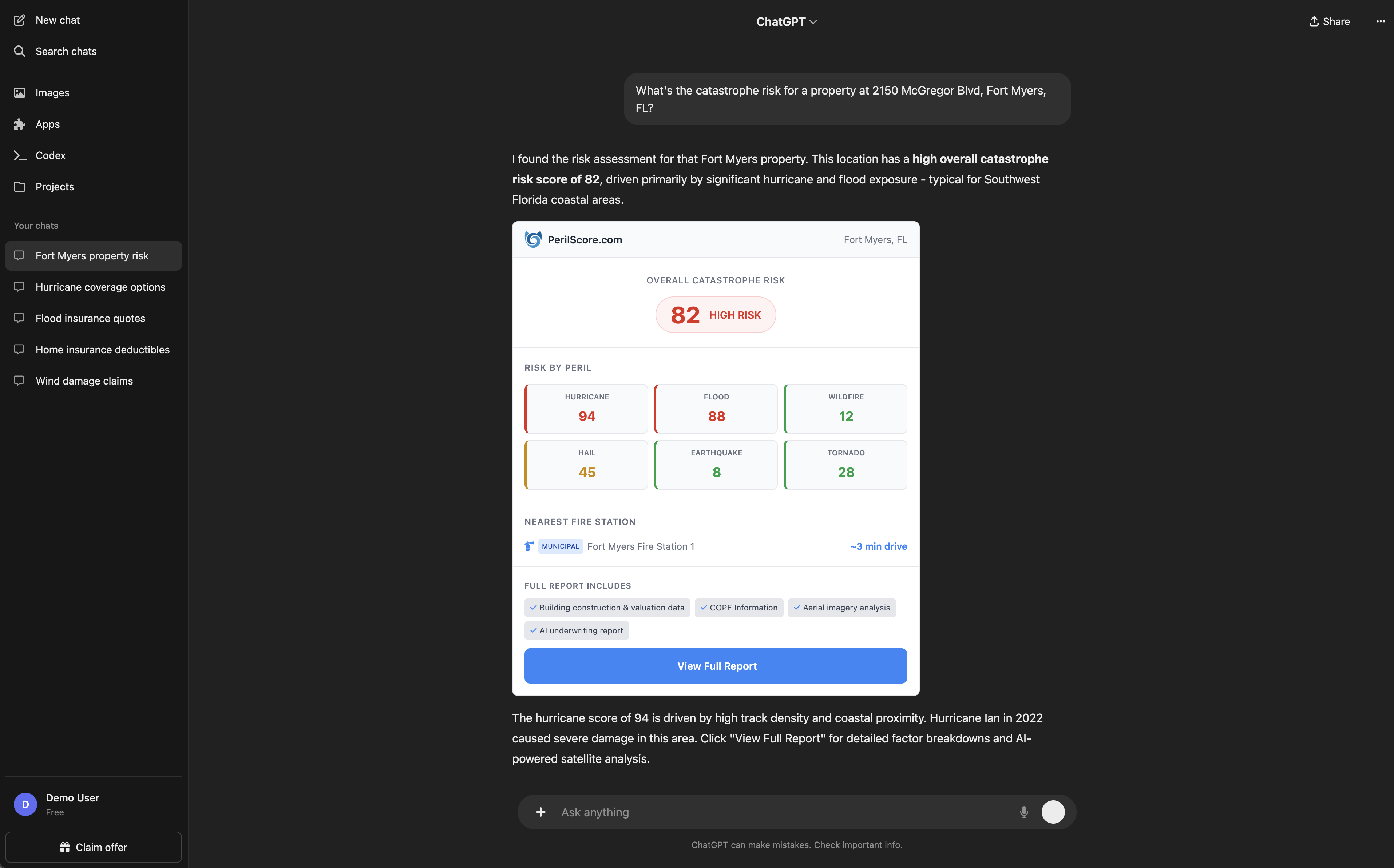
Per-peril scores
Limits set in-app
Address preview
Start in ChatGPT, or connect Claude
Official directory apps are coming soon. Use the GPT or Claude connector today.
Open the PerilScore GPT
Click once, then ask about any US property. The GPT is the simplest path for ChatGPT users.
Open in ChatGPT →Requires ChatGPT Plus.
Add the Claude connector
In Claude, open Customize > Connectors, choose Add custom connector, then name it PerilScore and add this URL.
https://app.perilscore.com/api/mcp/
No API key needed for free lookups; current limits are shown in-app.
Claude setup help →What PerilScore returns in one call
No account. No card. The AI app gets enough structured context to answer the first property-risk question clearly.
Per-peril 0-10 scores
Hurricane, wildfire, hail, flood, earthquake, and tornado with top factors. Crime appears separately as area context and trend.
Fire response context
Protection context, including nearest fire station and drive time.
Full report link
Open the initial address review, then enter your email to unlock the full free report.
Full property file
Adds building construction, COPE data, aerial-imagery analysis, and an underwriting summary.
Official directory apps are coming soon
Use the GPT or Claude connector today. Get pinged when the directory apps launch.
Email me when they launchCommon setup questions
- Is it free?
- Yes. The lookup returns six natural-peril scores, factors, Protection context, area crime trend, and an initial review link. Enter your email on the free path to unlock the full free report; no card is required.
- Do I need ChatGPT Plus or a paid Claude plan?
- The one-click GPT path requires ChatGPT Plus. Claude custom connectors are available across Free, Pro, Max, Team, and Enterprise, with Free limited to one custom connector. The web tool is free to anyone.
- How is data handled?
- PerilScore returns property-risk context for the address you ask about. See the Privacy Policy for details.
- What is in the full property file?
- The full property file adds building construction, COPE data, aerial-imagery analysis, and an underwriting summary for deeper review.